
Cup to grams, perfectly measured.
Baking is a science, and precision makes all the difference. Convert cup to grams — or grams to cup — instantly with accurate measurements for your favorite ingredients.
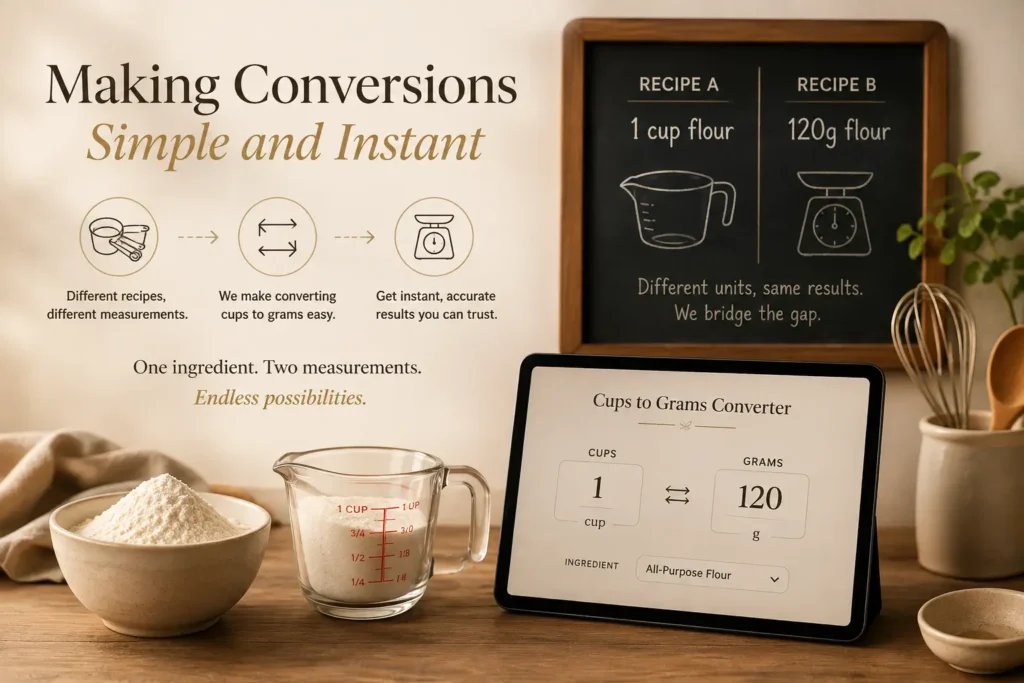
1 cup of All-Purpose Flour ≈ 120 g. Type into either field — the other updates instantly.
Our Purpose
Why Cup to Grams Tool Exists
Recipes don't always use the same measurement system. One recipe may list flour in cups, while another gives the measurement in grams.
Cup to Grams was created to make those conversions easier.
Instead of searching for individual conversion charts or trying to estimate measurements yourself, you can select an ingredient, enter your measurement, and get an instant conversion.
What We Do
Simple Conversions for Everyday Cooking
Our goal is straightforward: make ingredient conversions quick, accessible, and easy to understand.
With Our Cup to Grams Tool, you can:
Built for Bakers & Home Cooks
Whether you're following a recipe from another country, adapting an old family recipe, or simply prefer measuring ingredients by weight, Cup to Grams is designed to make the process easier. It's useful for:
Home Bakers
Get accurate measurements when preparing cakes, cookies, bread, pastries, and more
Home Cooks
Quickly convert ingredient quantities while preparing everyday meals.
Recipe Creators
Make recipes easier to follow by understanding measurements across different systems.
International Recipes
Switch between cups and grams without the guesswork.
How It Works
Simple Ingredient Conversions in Three Easy Steps
Convert everyday cooking measurements quickly and accurately. Our tool is designed to make ingredient conversions simple, even when you're working with different measurement systems.
Choose Your Ingredient
Start by selecting the ingredient you want to convert. Different ingredients can have different weights and densities, so choosing the correct ingredient helps provide a more accurate conversion.
Enter Your Measurement
Enter the amount you want to convert, such as cups or grams. Simply provide your measurement, and the tool will use it to calculate the corresponding value for your selected ingredient.
Get Your Conversion
View the converted measurement instantly. Your result is calculated based on the ingredient and amount you entered, giving you a clear measurement you can use directly in your recipe.
A Helpful Conversion Tool, Not a Substitute for a Scale
Cup measurements can vary depending on how an ingredient is packed, scooped, or measured. For professional baking or recipes where precision is especially important, measuring ingredients by weight with a kitchen scale is generally the better approach. Our conversions are intended as a practical guide for everyday cooking and baking.
Quick Reference
How Many Grams Is 1 Cup?
Every ingredient weighs something different per cup, because grams measure weight and cups measure volume.
Here's a quick reference for the most common baking ingredients.
| Ingredient (1 cup) | In grams |
|---|---|
| All-Purpose Flour | 120 g |
| Granulated Sugar | 200 g |
| Brown Sugar (Packed) | 213 g |
| Powdered Sugar | 113 g |
| Unsalted Butter | 227 g |
| Whole Milk | 242 g |
| Water | 236 g |
| Honey | 340 g |
| Cocoa Powder | 90 g |
| Rice, Uncooked | 185 g |
| Vegetable Oil | 218 g |
| Fine Sea Salt | 273 g |
Need a different amount? Use the converter above — select your ingredient and type into either field for an instant result.
The Formula
Grams = Cups × Density
Density is the ingredient-specific grams-per-cup value shown in the table above. Because dry, liquid, and packed ingredients all weigh differently, there's no single "1 cup = X grams" rule that works for everything — that's why this tool asks for your ingredient first.
2 cups flour: 2 × 120 = 240 g
1 cup butter: 1 × 227 = 227 g
1.5 cups sugar: 1.5 × 200 = 300 g
½ cup honey: 0.5 × 340 = 170 g
Manual Example — Converting ¾ Cup Butter 0.75 × 227 = 170 g Or type 0.75 into the Cups field above and let the converter handle it.
How It Works
Cup to Grams for Flour, Sugar & Butter
The three most-baked-with ingredients — and why technique changes their weight.
Flour
- Spoon & level: 120–125 g/cup
- Dip & sweep: ~140 g/cup
- Sifted: ~110 g/cup
A 20 g difference per cup can mean the gap between a light cake and a dense one.
Sugar
- Granulated: 200 g/cup
- Brown, packed: 220 g/cup
- Powdered: 120 g/cup
Brown sugar must be firmly packed — unpacked, it's closer to 180 g/cup.
Butter
- ¼ cup = 57 g (½ stick)
- ½ cup = 113 g (1 stick)
- 1 cup = 227 g (2 sticks)
US butter sticks are printed with measurement lines — a handy backup reference.
Why Grams Beat Cups (Most of the Time)
Cups are quick and don't require a scale, which is why they've stuck around in home kitchens for generations. But weight is a more honest measurement than volume — it doesn't change based on how firmly something is packed, how humid your kitchen is, or how the ingredient settled in the bag. That's why professional bakers, culinary schools, and most of the world outside the US measure by grams instead of cups, and why switching to a grams to cup mindset pays off even in a home kitchen. Here's what you gain by switching:
Removes scooping guesswork: No more wondering whether you packed the cup too tight or left it too loose. 120 g of flour is always 120 g, no matter who's measuring it or how it was scooped — one of the simplest reasons a grams to cup conversion beats eyeballing a cup by hand.
Unaffected by settling or humidity: Flour and sugar settle and compact during storage and shipping, which changes how much fits in a cup. A gram measurement stays accurate regardless of how the ingredient has settled, which is exactly why a grams to cup conversion holds up better over time than a volume measurement does.
Easy to scale: Doubling or halving a recipe is simple arithmetic in grams — 240 g becomes 480 g instantly. Doing the same with 1⅔ cups means converting to fractions and back, which is where scaling mistakes creep in; running the numbers through a grams to cup conversion first avoids that altogether.
Works the same in every country: A recipe written in grams means the same thing everywhere — London, Lahore, or Los Angeles. There's no need to look up what a "cup" means in a different country's kitchen, since cup sizes themselves aren't even fully standardized worldwide, which makes a grams to cup reference genuinely universal.
Matches nutrition-label units for tracking: If you're counting calories or macros, ingredient weights in grams line up directly with nutrition labels and food databases, making portion tracking far more accurate than volume-based guesses.
The professional/culinary-school standard: Professional bakeries and culinary schools weigh nearly everything, because repeatable results matter when you're producing the same recipe at scale, day after day. Learning a reliable grams to cup conversion is a step toward baking the way professionals do.
In the Kitchen
Real Recipe Examples
See how these conversions play out in everyday baking:
| Recipe | Ingredient | Cups | Grams |
|---|---|---|---|
| Chocolate Chip Cookies | All-purpose flour | 2 cups | 240 g |
| Granulated sugar | 1 cup | 200 g | |
| Brown sugar, packed | 1 cup | 220 g | |
| Butter | 1 cup | 227 g | |
| Chocolate chips | 1 cup | 170 g | |
| Fluffy Pancakes | All-purpose flour | 1½ cups | 180 g |
| Granulated sugar | ¼ cup | 50 g | |
| Milk | 1 cup | 240 g | |
| Butter, melted | ¼ cup | 57 g | |
| Classic Apple Pie | All-purpose flour (crust) | 3 cups | 360 g |
| Granulated sugar (filling) | 1 cup | 200 g | |
| Cold butter | 1 cup | 227 g | |
| Honey (optional glaze) | 1 cup | 340 g | |
| Birthday Cake | All-purpose flour | 2½ cups | 300 g |
| Granulated sugar | 2 cups | 400 g | |
| Cocoa powder | 1 cup | 100 g | |
| Milk | 1 cup | 240 g | |
| Vegetable oil | ½ cup | 109 g | |
| Banana Bread | All-purpose flour | 2 cups | 240 g |
| Granulated sugar | ¾ cup | 150 g | |
| Butter, melted | ⅓ cup | 76 g | |
| Mashed banana | 1 cup | 225 g | |
| Chopped walnuts | ½ cup | 60 g | |
| Homemade Bread | Bread flour | 3½ cups | 420 g |
| Water | 1¼ cups | 296 g | |
| Fine sea salt | 1½ tsp | 9 g | |
| Honey | 2 tbsp | 43 g | |
| Brownies | All-purpose flour | 1 cup | 120 g |
| Cocoa powder | ½ cup | 45 g | |
| Granulated sugar | 1½ cups | 300 g | |
| Butter, melted | ½ cup | 113 g | |
| Chocolate chips | ¾ cup | 128 g | |
| Oatmeal Cookies | Rolled oats | 2 cups | 180 g |
| All-purpose flour | 1 cup | 120 g | |
| Brown sugar, packed | 1 cup | 220 g | |
| Butter, softened | ¾ cup | 170 g | |
| Raisins | ½ cup | 75 g | |
| Fried Rice | White rice, uncooked | 2 cups | 370 g |
| Vegetable oil | 2 tbsp | 27 g | |
| Soy sauce (for reference) | 2 tbsp | 30 g |
Use the converter above to check any of your own recipe amounts instantly.
Frequently Asked Questions
Ready to Convert?
Stop guessing and start measuring with confidence.